

Silicosis Now a Reportable Disease as State Faces Growing Crisis Linked to Artificial Stone Fabrication
On November 17, 2025, the California Department of Public Health (CDPH) added a critical Health Advisory to its website, alerting healthcare providers and local health departments about the escalating number of silicosis cases among artificial stone countertop workers across the state. This update marks a pivotal moment in California's public health response to a severe occupational disease that has claimed lives, changed regulations, and spurred urgent calls for action.
Silicosis: A Severe, Incurable Threat Facing Artificial Stone Countertop Workers
Artificial stone silicosis is a progressive, incurable lung disease caused by inhaling nano-sized particles of respirable crystalline silica during the cutting, grinding and polishing of artificial stone countertops. While silicosis has long been recognized as a workplace hazard, the surge in cases linked to artificial stone — also known as “engineered stone” and often marketed as “quartz countertops” — has triggered a new wave of concern. These materials contain exceptionally high levels of crystalline silica and other toxins, putting workers at particularly high risk.
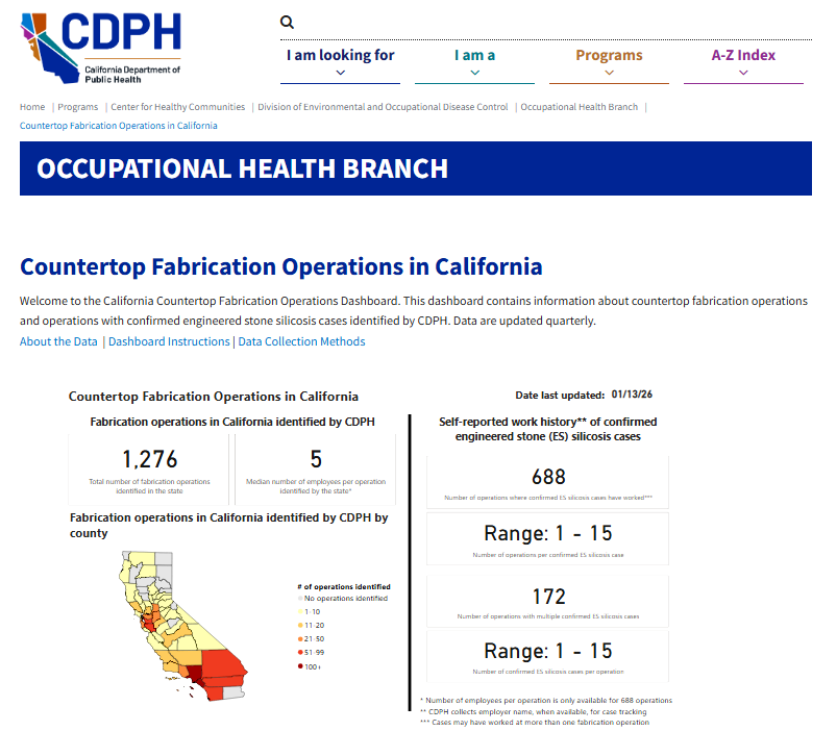
To better understand and track this evolving crisis, the CDPH has maintained a Silicosis Dashboard tracking fabrication workers silicosis diagnoses from 2019 to the present. Only 13 cases were confirmed for 2019. However, the epidemic has grown rapidly: as of November 20, 2025, the number of confirmed cases has soared to 435. Tragically, this includes 25 deaths and 48 individuals who have undergone lung transplants. The dashboard provides vital, up-to-date statistics and is an essential tool for public health officials and the public to monitor the spread and impact of artificial stone silicosis in California countertop fabrication workers.
Many of these cases are concentrated among relatively young individuals, with a median age at diagnosis of 46 and a median age of death of just 48.
Silicosis Now a Reportable Disease in California
In a significant regulatory shift, artificial stone silicosis became a reportable disease in California as of June 2025. This means healthcare providers are now required to report identified or suspected cases to local health departments within seven days, helping public health authorities track the spread and impact of the disease more effectively. Local departments then relay these cases to CDPH for statewide surveillance and intervention. However, even with the new requirements, reporting is still incomplete and inconsistent, such that the reported cases likely represent just a fraction of the actual cases.
Reporting is essential not only for tracking the disease but also for connecting affected workers to needed care and resources. Providers are urged to ask patients about their occupational history — specifically, any experience with cutting or finishing countertops — and to conduct testing even in the absence of symptoms. Early diagnosis can help manage the disease and potentially slow its progression, though prevention remains the goal.
Countertop Workers at Highest Risk: Artificial Stone Drives Epidemic
The rise in silicosis cases is closely tied to the popularity of artificial stone slabs for fabrication, which contains much more crystalline silica, and much smaller size silica particles, than natural stone, as well as other toxins not present in natural stone or recycled glass sone. Workers exposed to dust from cutting and finishing these materials face a dramatically elevated risk. Globally, this has led to an artificial stone silicosis epidemic, with cases documented in many countries. In July 2024, Australia became the first nation to ban crystalline silica artificial stone following hundreds of cases among its own countertop fabrication workers — a move that underscores the gravity of the problem and the challenges in controlling silica dust exposure.
California’s County-Level Impact: Los Angeles, Orange, and Beyond
According to CDPH’s latest data, silicosis cases are concentrated in several counties:
- Los Angeles: 226 cases
- Orange: 86 cases
- San Diego: 34 cases
- Contra Costa: 19 cases
- Alameda: 15 cases
- San Bernardino: 13 cases
- Riverside: 10 cases
These figures likely underestimate the true burden, as many cases may go undiagnosed or unreported. For the most current information, the CDPH Silicosis Dashboard provides ongoing updates.
Why Prevention Is So Challenging
While silicosis is preventable, control of silica dust requires costly and technically sophisticated equipment. Cal/OSHA mandates measures such as wet cutting methods, prompt dust cleanup, powered air-purifying respirators (PAPRs), and regular dust monitoring. However, even with these regulations in place and full compliance by employers, these mechanisms do not prevent disease from artificial stone countertop fabrication. Simply put, mandated controls are not sufficient for artificial stone, and workers continue to fall ill. Numerous peer-reviewed scientific studies have shown that there is no safe way for artificial stone to be fabricated be humans. A ban on the manufacture and sale of crystalline silica artificial stone slabs is the only way to stop this epidemic.
Recommendations for Healthcare Providers and Local Health Departments
CDPH’s advisory calls for active surveillance by healthcare providers, including:
- Asking patients about jobs involving countertop fabrication or finishing
- Considering silicosis in both symptomatic and asymptomatic workers
- Using imaging and pulmonary function tests for diagnosis
- Referring patients early to pulmonary and occupational medicine specialists
- Sharing educational resources and advising on workplace safety practices
Dissemination of information to healthcare networks, especially those serving immigrant and underinsured populations, is a key strategy for early intervention.
Legislative Changes: Senate Bill 20
Looking ahead, Senate Bill 20, effective January 2026, will require CDPH to report silicosis cases related to artificial stone to Cal/OSHA for investigation. It will also permit CDPH to share case information with local health officers for surveillance and case management.
Resources and Support
The CDPH Occupational Health Branch website provides educational resources for employers and workers, along with technical guidance for local health departments and providers. Additional information is available from the CDC NIOSH website, including medical monitoring guidelines, and from the American Thoracic Society, which offers patient education materials.
Conclusion: A Call to Action
California’s newly updated Health Advisory, coupled with the Artificial Stone Surveillance Dashboard, highlights a growing crisis that demands urgent attention from manufacturers and suppliers of artificial stone slabs. As silicosis becomes a reportable disease, improved reporting may help to shed light on this occupational health catastrophe. The tragedy of young workers suffering and dying from a preventable disease underscores the need for aggressive intervention — ensuring that those who contribute to the building of our homes and businesses are not left behind.
At Brayton Purcell LLP, we are dedicated to fighting for change and holding those responsible accountable. If you or a loved one has worked in the artificial stone countertop fabrication industry and need assistance, please contact us today. Our experienced team is committed to advocating for your rights and ensuring you receive the support and justice you deserve. Reach out to us at Brayton Purcell LLP and let us help you navigate this challenging time.