
Artificial Stone Silicosis: The Modern Occupational Disease Drawing Comparisons to Black Lung Disease
September 17, 2026
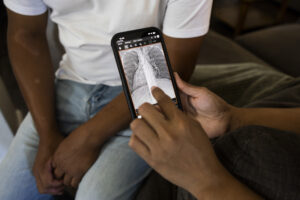
Eleazar Resendiz Cortes’ wife shows scans of his chest that revealed particles around his lungs linked to his silicosis diagnosis, in their home in Bakersfield, California, on May 14, 2026. (Julie Leopo for KQED)
California has taken a significant step toward addressing the state's artificial stone silicosis epidemic. On September 16, 2026, the California Division of Occupational Safety and Health (Cal/OSHA) released the draft emergency regulation that would prohibit the manufacture and fabrication of artificial stone containing more than 1% crystalline silica.
When adopted, the proposal would make California the first state in the nation to ban crystalline silica artificial stone slab countertop fabrication in response to the growing number of artificial stone countertop fabrication workers diagnosed with artificial stone silicosis, a progressive, irreversible, fatal lung disease caused by inhaling respirable crystalline silica dust.
Why California Is Considering an Artificial Stone Ban
Artificial stone, commonly used for kitchen and bathroom countertops, contains at least 90% crystalline silica. The remaining material is composed of resins, pigments, adhesives, and other highly toxic substances. During fabrication activities such as cutting, grinding, and polishing, workers are exposed to airborne nano-sized high-surface area crystalline silica particles that penetrate deep into the lungs.
Hundreds of global medical researchers and occupational health professionals have unanimously linked crystalline silica artificial stone fabrication to accelerated silicosis, a form of the disease that develops after shorter exposure periods and progresses more rapidly than traditional forms of silicosis associated with mining and other industries.
California regulators concluded that crystalline silica artificial stone presents unique hazards because of its exceptionally high silica content, the nano-sized high-surface area nature of the particles generated during fabrication, and the material's overall composition. Hundreds of published peer-reviewed studies have shown that due to its ‘unique toxicity’ crystalline silica artificial stone cannot be fabricated safely by human beings, regardless of protections put in place such as sophisticated ventilation systems and advanced personal protection equipment.
Hundreds of California Workers Have Been Diagnosed
The draft regulation comes amid a continuing rise in artificial stone silicosis cases among countertop fabrication workers throughout California.
As of September 2026, California had confirmed 644 cases of silicosis and 35 deaths associated with artificial stone fabrication. Health officials have reported that the number of diagnosed workers has increased dramatically in recent years, prompting physicians, regulators, and worker advocates to call for stronger action.
Many affected workers were relatively young when diagnosed and developed severe disease after comparatively short periods of exposure.
The WOEMA Petition That Helped Drive Action
The draft emergency regulation follows action taken by the California Occupational Safety and Health Standards Board earlier this year when it granted Petition 609.
The petition was submitted by more than 600 physician members of the Western Occupational and Environmental Medical Association (WOEMA). The physicians urged California regulators to prohibit fabrication and installation activities involving artificial stone because available control measures cannot successfully prevent workers from developing silicosis.
The petition marked a significant milestone in California's effort to address the growing public health crisis associated with artificial stone fabrication.
What the Draft Emergency Regulation Would Do
The draft regulation would prohibit the manufacture and fabrication of artificial stone containing more than 1% crystalline silica. The phaseout would occur over several months.
Step One: Initial Implementation
Under the new regulation, fabricators would be prohibited from acquiring from manufacturers, distributors, importers, and suppliers new artificial stone slabs containing more than 1% crystalline silica beginning 60 days after the emergency regulation becomes effective.
If the regulation is approved by the Cal/OSHA Standards Board during its October or November 2026 meeting, the rule could become effective as early as December 2026 or January 2027.
Step Two: Inventory Transition Period
The regulation includes a limited inventory transition period.
During that period, fabrication shops would be permitted to continue fabricating crystalline silica artificial stone that was purchased, contracted for, or already in their possession prior to the regulation's effective date.
However, all fabrication of artificial stone slabs containing more than 1% crystalline would be prohibited 180 days after the regulation becomes effective, regardless of when the material was acquired.
As a practical matter, if the regulation takes effect in December 2026 or January 2027, fabrication shops would have approximately six months to transition existing inventory before the prohibition is fully implemented.
Why Regulators Believe Existing Controls Are Not Enough
California's proposed rule is based on extensive scientific research and regulatory findings.
Cal/OSHA reviewed evidence indicating that crystalline silica artificial stone is uniquely dangerous because of its high concentration of crystalline silica and the characteristics of the dust generated during fabrication. The agency found that workers are exposed to hazardous levels of respirable crystalline silica even in advanced facilities that comply with existing standards and utilize dust-control measures.
Regulators also noted that some of the most sophisticated fabrication shops continue to report cases of silicosis among workers despite significant investments in engineering controls and respiratory protection programs.
Cal/OSHA ultimately concluded that eliminating worker exposure to ‘uniquely toxic’ crystalline silica artificial dust is the only effective method of preventing future cases of the disease.
Lessons From Australia
California's regulation follows similar action taken in Australia.
After experiencing its own outbreak of artificial stone silicosis, Australia implemented a nationwide prohibition on crystalline silica artificial stone in July 2024. Australian regulators concluded that enforcement efforts and workplace controls could not adequately protect workers from silica exposure.
According to reports reviewed by California regulators, Australia successfully transitioned to alternative countertop materials such as recycled glass slabs made with non-toxic amorphous silica, and less toxic natural stone, without disruption to consumers or job losses. A variety of substitute products remain available in the marketplace and continue to be used throughout the country.
What Happens Next?
Cal/OSHA is accepting public comments on the draft regulation through September 30, 2026.
After the comment period closes, the proposal will move to the Cal/OSHA Standards Board for a final vote. When approved, California will become the first U.S. state to prohibit the fabrication of artificial stone containing high concentrations of crystalline silica.
For workers and families affected by artificial stone silicosis, the proposal represents the most significant development to date in efforts to prevent future cases of the disease.
Have You Been Diagnosed with Silicosis After Working with Artificial Stone?
Workers who fabricated, cut, polished, installed, or otherwise handled artificial stone countertops may have been exposed to dangerous levels of respirable crystalline silica.
If you or a loved one has been diagnosed with artificial stone silicosis, pulmonary fibrosis, progressive massive fibrosis, or another silica-related lung disease after working with artificial stone, it is important to understand your legal options.
Brayton Purcell LLP represents workers and families affected by occupational diseases and toxic exposures nationwide. Our attorneys have extensive experience handling silica-related claims and remain committed to helping workers and their families pursue accountability from those responsible for placing dangerous products into the marketplace.
Contact Brayton Purcell LLP today for a confidential consultation.