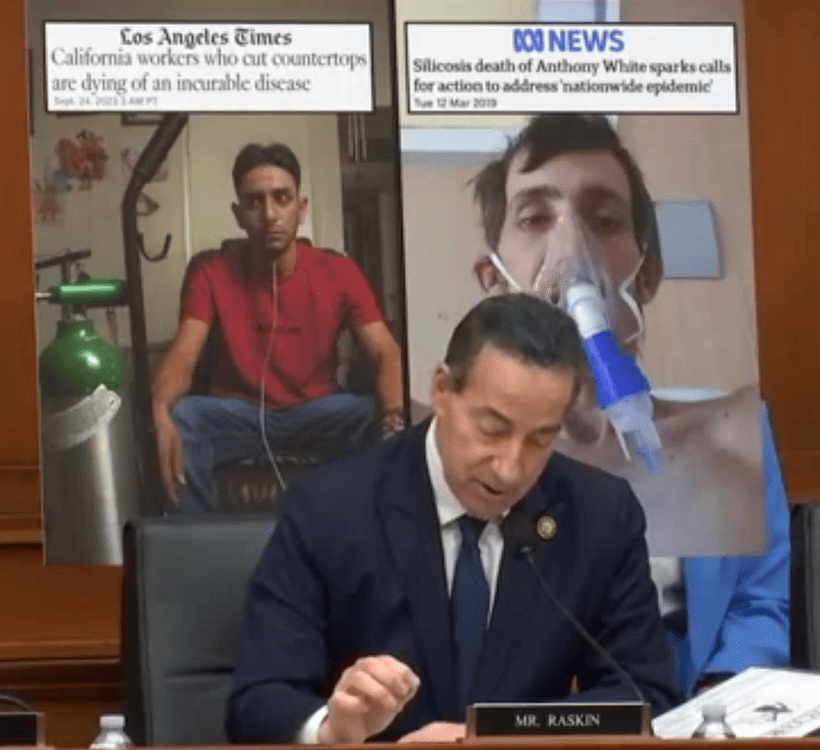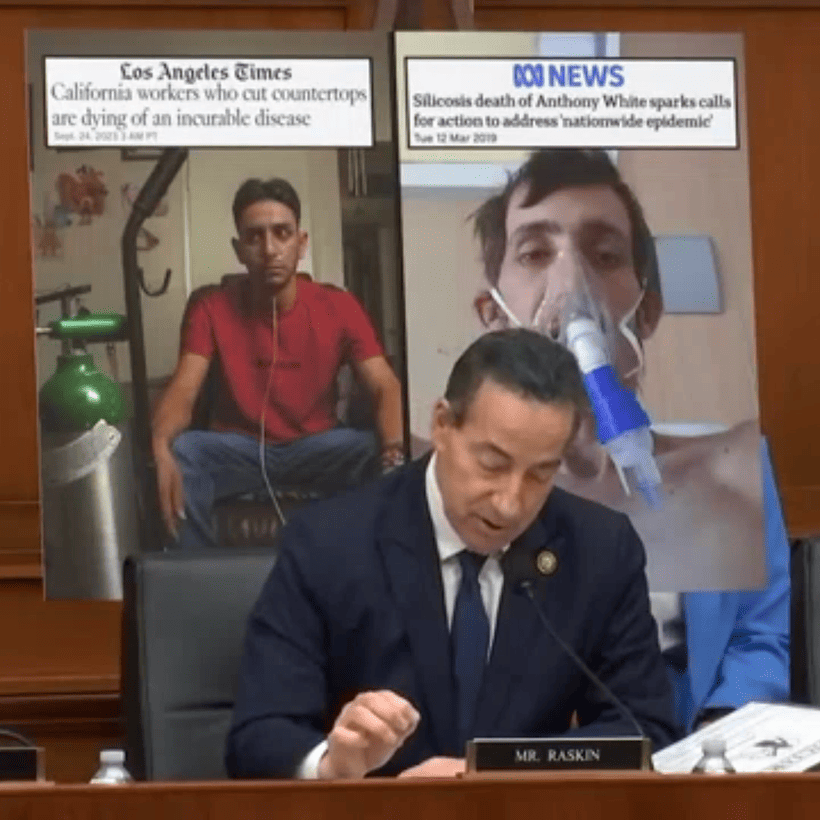

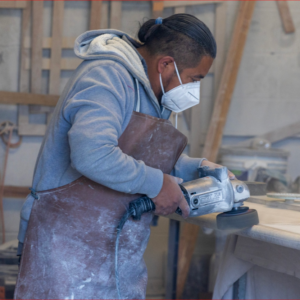
California is grappling with a surge in silicosis cases linked to crystalline silica artificial stone, a material widely used for countertops that contains at least 90% crystalline silica and releases nano-sized particles during fabrication. These particles cause irreversible lung damage, leading to an aggressive, fatal and incurable disease. As the health toll rises, the (mostly foreign) slab manufacturers and distributors are pushing for immunity through H.R.5437 – Protection of Lawful Commerce in Stone Slab Products Act, sparking intense debate in Washington, D.C.
This issue was recently highlighted in a report by Farida Jhabvala Romero for KQED, which examined the growing epidemic and countertop slab manufacturer’s efforts to secure immunity from lawsuits.
The Growing Health Emergency for Fabrication Workers
Silicosis caused by the fabrication of crystalline silica artificial stone is not a distant threat—it is here and escalating. California health authorities have confirmed more than 480 cases among countertop workers, with dozens of lung transplants and 27 deaths since 2019. Experts believe these numbers represent only a fraction of the true scope, as many workers lack access to healthcare or fear reporting illness.
This disease disproportionately affects immigrant workers employed in small fabrication shops, where multi-million-dollar robotic systems are out of reach. Even in facilities with modern safeguards, cases persist, underscoring the extreme unique toxicity of the material. Over 100 peer reviewed medical studies have shown that crystalline silica artificial stone slabs cannot be fabricated safely by human beings.
What H.R.5437 Would Mean for Workers and Lawsuits
The proposed legislation would prohibit civil lawsuits against (the mostly foreign) manufacturers and distributors of crystalline silica artificial stone slabs for harm resulting from normal foreseeable fabrication using their defective product, such as cutting slabs into countertops. It would also dismiss hundreds of pending cases, leaving workers with no options for justice.
Critics argue that removing legal accountability would undermine efforts to protect workers and incentivize safer alternatives. As one public health authority warned:
“Lawsuits play an important role in public health protection. If lawsuits by workers with silicosis are prohibited, these manufacturers will make no effort to prevent more workers from dying or becoming disabled by silicosis.” — David Michaels, former OSHA Assistant Secretary
Why This Product is So Inherently Hazardous
Crystalline silica artificial stone is marketed as a durable and attractive countertop material, but its composition makes it uniquely hazardous. It contains extremely high concentrations of crystalline silica—often exceeding 90%—and toxic metals and resins and carcinogens known as VOCs. When slabs are cut, polished, or drilled, they release respirable crystalline silica (RCS) particles that penetrate deep into the lungs, causing accelerated silicosis. Unlike the regular large particle crystalline silica dust produced when fabricating safer products like natural stone or the non-toxic amorphous silica dust from fabricated recycled glass stone slabs, the crystalline silica particles that make up 90-95% of the artificial stone material’s composition are also nano-sized and coated with toxic metals and resins that simply cannot be mitigated with PPE or engineering controls,
Medical professionals have been clear:
“Artificial stone cannot be fabricated safely. These products contain extremely high concentrations of crystalline silica—often exceeding 90%. Even with modern dust controls, cutting, grinding, and polishing artificial stone releases respirable silica at levels that overwhelm existing engineering and personal protective measures.” — Dr. Jane Fazio and Dr. Sheiphali Gandhi
Lessons from Abroad: Australia’s Ban
Australia banned crystalline silica artificial stone in 2024 after determining that safe fabrication was not feasible. Manufacturers quickly adapted, introducing silica-free recycled glass alternatives that mimic the look and durability of traditional crystalline silica artificial stone products. This shift demonstrates that eliminating hazardous materials is possible without sacrificing design or economic viability.
Ms. Romero’s article points out that Rebecca Shult, Cambria’s chief legal officer, said “Cambria faces 400 lawsuits from stoneworkers for silica-related injuries, most of them in California,” What Shult failed to state, but Romero tells her readers, is that “Other major manufacturers facing lawsuits, such as Israel-based Caesarstone and Cosentino, headquartered in Spain, have developed low or no-crystalline silica alternatives. But Cambria, which owns a quartz mine that supplies its high-silica products, has not.” Those low or no-crystalline silica products are all that is used in Australia now and are readily available in the U.S.
What Lawmakers Are Saying
Opponents of H.R.5437 argue that the bill prioritizes corporate interests over worker health.
“Congress would make a billionaire CEO’s problems go away just like that, while the workers who cut, grind, polish, and install this dangerous product struggle to make ends meet, struggle to stay alive.” — Rep. Hank Johnson, Georgia
Maryland Rep. Jamie Raskin questioned the slab manufacturers’ request for blanket immunity:
“You are looking for categorical absolute immunity in all of these cases. On your definition, there’s no defect on the product, right? So how could you ever be held liable?” — Rep. Jamie Raskin, Maryland
Workers Deserve Accountability
Silicosis caused by crystalline silica artificial stone is entirely preventable—but only if hazardous products are replaced with safer alternatives. Immunity under H.R.5437 would not protect workers; it would protect the corporate profits of foreign companies and Cambria USA. As lawmakers debate this bill, the stakes are clear: accountability saves lives.
Contact Brayton Purcell LLP for Legal Support
If you, a family member, or a friend worked in crystalline silica artificial stone countertop fabrication, you have been exposed to dangerous artificial stone dust. Brayton Purcell LLP has a knowledgeable, experienced and accomplished legal team ready to help you understand your rights and explore available options.
Contact us today for more information or confidential assistance:
Phone: (800) 361-2417