
The U.S. Crisis: California, Massachusetts, and the Emerging National Epidemiology
March 4, 2026
Molecular Biomarkers and Pleural Mesothelioma: What New Science Means for Asbestos Victims
March 9, 2026
Legislation, Hearings, and Government Responses: SB 20, HR 5437, and Cal OSHA Testimony
As artificial stone silicosis cases continue to rise across the United States, lawmakers, regulators, and public health authorities have begun addressing the severe and expanding crisis affecting countertop fabrication workers. While scientific research clearly establishes that artificial stone contains at least 90% silica in nano‑sized particles and approximately 10% VOCs and other toxins, legislative and regulatory responses vary widely in effectiveness and intent.
Three major areas define the current U.S. governmental response: California’s SB 20, the federal HR 5437 bill, and the Cal OSHA Standards Board and congressional hearings where medical and occupational authorities have provided testimony on the dangers of artificial stone.
California Senate Bill 20: A Well‑Intended but Ineffective Law
In 2025, California enacted Senate Bill 20 (Menjivar)—a law intended to address high‑exposure tasks during artificial stone fabrication. However, extensive examination by medical professionals, workers, and legal advocates shows that SB 20 does not address the underlying hazards created by artificial stone.
Key Problems with SB 20
- SB 20 criminalizes dry fabrication tasks that are unavoidable.
Artificial stone is often sold in thinner 2 cm slabs, which require dry lamination to achieve necessary thickness. SB 20 effectively forces workers into a “catch‑22”:
Dry fabrication becomes a crime, yet many shops cannot complete required tasks without it. - SB 20 includes no increase in Cal OSHA enforcement funding.
California fabrication shops rarely receive Cal OSHA inspections. One analysis notes that a shop is “more likely to be struck by lightning than visited by Cal OSHA,” and SB 20 does nothing to expand staffing or enforcement resources. - SB 20 imposes unrealistic costs on small fabricators.
Minority‑owned and small‑scale shops typically cannot afford the millions of dollars in equipment required for compliance, especially when sophisticated controls have already been shown not to eliminate exposure. - SB 20 was heavily influenced by foreign slab manufacturer lobbyists.
The bill was edited without input from California Department of Public Health (CDPH) occupational doctors or Cal OSHA medical staff. Evidence shows the law reflects the priorities of foreign slab manufacturers rather than the needs of workers. - SB 20 fails because it assumes artificial stone can be fabricated safely.
Medical and scientific authorities—including NIOSH, OSHA, SafeWork Australia, and CDPH—have documented that no safety method can bring crystalline silica artificial stone exposures into an acceptable range.
Outcome: SB 20 deepens rather than reduces the crisis
Because SB 20 does not address the core hazard—the material itself—it is expected to:
- Increase underground or non‑compliant operations
- Burden small businesses
- Fail to reduce silicosis rates
- Support misleading industry narratives that the hazard arises from fabrication practices rather than the product itself
Regulatory evidence shows that artificial stone created the epidemic, not worker behavior or shop structure.
Federal HR 5437: A Bailout Bill to Block Lawsuits Against Artificial Stone Manufacturers
In contrast to SB 20’s focus on fabrication practices, the federal HR 5437 bill takes aim at the legal rights of workers harmed by respirable crystalline silica exposure through the fabrication of crystalline silica artificial stone.
What HR 5437 Proposes
- HR 5437 would prohibit civil lawsuits in the United States against manufacturers, distributors, and sellers of artificial stone slabs.
- The bill is strongly supported by foreign slab manufacturers and trade associations aligned with them.
Why the Bill Raises Significant Concerns
- It shields companies producing a uniquely hazardous product.
Medical evidence presented in federal hearings shows that artificial stone releases nano‑sized silica dust particles that cannot be controlled through even the most advanced safety measures. - It eliminates the only mechanism that has historically held manufacturers accountable.
Testimony from Dr. David Michaels, former Assistant Secretary of OSHA, emphasized that civil litigation often forces manufacturers to improve product safety. Eliminating this pressure removes a critical safeguard for workers. - It contradicts global findings that artificial stone is too toxic for human fabrication.
Hundreds of peer‑reviewed scientific studies and international regulatory bodies agree that artificial stone cannot be safely fabricated by workers. - HR 5437 ignores successful international models.
Australia banned artificial stone in 2024 and transitioned smoothly to safer materials such as recycled glass slabs, with no job losses and no industry collapse.
Worker Testimony Highlights the Real‑World Harm
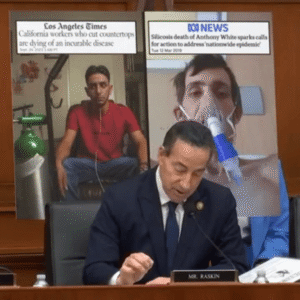
Workers like Tyler Jordan, featured in national investigative reporting, expressed deep concern over HR 5437, noting that removing accountability would leave workers unprotected despite the severe, irreversible harm caused by artificial stone exposure.
Cal OSHA Standards Board Hearings: Scientific and Medical Consensus
In January and February 2026, the Cal OSHA Standards Board held meetings addressing artificial stone silicosis. These meetings revealed critical insights:
- WOEMA’s Petition to Prohibit Artificial Stone
The Western Occupational and Environmental Medical Association (WOEMA)—representing more than 600 U.S. occupational medicine physicians—petitioned the board to prohibit artificial stone containing more than 1% crystalline silica.
Their conclusion, based on extensive scientific evaluation:
Crystalline silica artificial stone is too toxic for human fabrication.
It releases nano‑sized silica dust particles and toxic chemicals that cannot be adequately controlled in workplace settings.
- Medical and Scientific Staff at Cal OSHA Agree
Cal OSHA’s own medical and scientific team repeatedly stated:
- Artificial stone cannot be fabricated safely
- The global evidence shows rapid disease progression and high fatality rates
- Safer alternatives already exist
- They have compiled the medical evidence for board review
Despite this, the board chair repeatedly requested evidence from foreign slab manufacturer lobbyists instead.
- Unequal Hearing Access
Evidence presented during the meetings documented:
- WOEMA was not allowed to present its petition in full
- Foreign slab manufacturer organizations, including ISFA, and Cambria, the only major U.S. manufacturer of artificial stone slabs, were given extensive time to present counterarguments
- Worker advocates and physicians received significantly restricted speaking time
This imbalance raised concerns about undue industry influence.
Conclusion
Legislative and regulatory responses in the United States show a stark divide. California’s SB 20—altered heavily by slab manufacturer lobbyists—fails to address the unique toxicity of artificial stone and instead places additional burdens on workers and small shops. At the federal level, HR 5437 proposes to remove legal accountability from the companies who produce and distribute artificial stone, despite extensive scientific evidence documenting its hazards.
Meanwhile, Cal OSHA hearings and testimony from leading occupational physicians demonstrate a clear medical consensus: artificial stone cannot be fabricated safely by human workers, and the rapidly growing epidemic of silicosis is caused by the material itself.
A full understanding of the legislative landscape reveals not only the scale of the crisis, but also the challenges workers face as they seek recognition, protection, and recourse for the harm caused by artificial stone exposure.