

California Moves Closer to Finalizing Its Ban on Crystalline Silica Artificial Stone as Regulators Release Draft Emergency Rule
September 21, 2026
For individuals diagnosed with mesothelioma, lung cancer, or other serious cancers linked to asbestos exposure, medical imaging plays a vital role in diagnosis, treatment planning, and ongoing care. While CT scans and traditional MRI remain essential tools, newer technologies are giving physicians a more detailed understanding of how cancer behaves inside the body.
One of the most promising developments is diffusion-weighted magnetic resonance imaging (DW-MRI), a specialized form of MRI that evaluates the movement of water molecules within tissues. Unlike conventional imaging, which primarily shows the size and shape of tumors, diffusion-weighted MRI can provide insights into tumor activity at a cellular level.
For patients facing asbestos-related diseases, advances in imaging technology may help physicians detect disease earlier, assess treatment effectiveness more accurately, and make more informed decisions about ongoing care.
What Is Diffusion-Weighted MRI?
Diffusion-weighted MRI is a specialized imaging technique that measures how water molecules move through tissues. This movement, known as diffusion, varies depending on the structure and density of cells within the body.
Cancerous tumors often contain tightly packed cells that restrict the movement of water molecules. As a result, these tumors can appear differently on diffusion-weighted images than healthy tissue. By identifying these differences, radiologists can gain additional information about suspicious lesions and areas of disease.
Another advantage of diffusion-weighted MRI is that it can often be performed without the use of contrast dye. This may be beneficial for some patients who cannot receive certain contrast agents due to kidney concerns or other medical conditions.
Why Diffusion Imaging Matters for Cancer Patients
Traditional imaging focuses on anatomy. Physicians use those images to determine whether tumors are growing, shrinking, or remaining stable.
Diffusion-weighted MRI offers another layer of information by helping doctors evaluate what is happening inside the tumor itself. The technology can provide clues about:
- Tumor cellularity
- Tissue density
- Areas of tumor activity
- Treatment-related changes
- Disease progression
This additional information can be especially valuable when evaluating cancers that require ongoing monitoring, including mesothelioma and other asbestos-related malignancies.
Improving Cancer Detection
One of the most significant benefits of diffusion-weighted imaging is its ability to help identify cancerous tissues that may be difficult to detect using conventional imaging alone.
Because many cancers restrict water movement more than normal tissue, they often appear more prominent on diffusion-weighted scans. Researchers have found that diffusion-weighted MRI may improve the detection of metastatic disease in several areas of the body, including the liver, abdomen, pelvis, and lymph nodes.
For patients diagnosed with mesothelioma or asbestos-related lung cancer, accurate imaging is critical. Physicians must understand not only where tumors are located but also whether cancer has spread beyond the original disease site.
Better visualization of disease can help support informed treatment decisions and more accurate staging.
Helping Distinguish Cancer from Benign Conditions
Not every abnormal finding on an imaging scan is cancer.
One challenge facing physicians is determining whether a lesion is malignant or benign. Diffusion-weighted MRI provides additional information that may help radiologists evaluate suspicious findings more accurately.
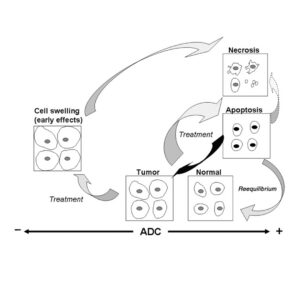
The technology generates measurements known as apparent diffusion coefficient (ADC) values. These values help quantify how freely water molecules move through tissue. In general, cancerous lesions often have lower ADC values than many benign abnormalities because malignant tumors tend to be more densely cellular.
However, diffusion-weighted MRI is not a standalone diagnostic tool. Physicians typically use it alongside CT scans, PET imaging, biopsy results, pathology findings, and a patient's clinical history to arrive at a diagnosis.
Monitoring Treatment Response Earlier
One of the most exciting applications of diffusion-weighted MRI involves monitoring how cancer responds to treatment.
Traditionally, doctors evaluate treatment effectiveness by measuring changes in tumor size. However, tumors may not shrink immediately after chemotherapy, radiation therapy, or immunotherapy begins.
Diffusion-weighted MRI can detect microscopic changes inside a tumor before visible size reductions occur.
When treatment successfully damages cancer cells, cell membranes begin to break down, and water molecules can move more freely through affected tissue. These cellular changes may be detected on diffusion-weighted imaging weeks before conventional scans reveal obvious physical changes.
Earlier assessment of treatment response may help physicians determine whether a therapy is working and whether adjustments should be considered.
For cancer patients, this could mean more personalized and effective treatment strategies.
Predicting How Tumors May Respond to Treatment
Researchers have also explored whether diffusion-weighted MRI can help predict treatment outcomes before therapy begins.
Studies suggest that certain diffusion characteristics may be associated with better responses to chemotherapy and radiation therapy. Tumors with specific cellular patterns may be more sensitive to treatment, while others may be more resistant.
Although additional research is needed, this area of investigation reflects a broader trend toward precision medicine. Rather than applying a one-size-fits-all approach, physicians increasingly seek ways to tailor treatment plans to the characteristics of each patient's disease.
Future developments in diffusion imaging may help guide treatment selection and improve outcomes for cancer patients.
The Potential of Whole-Body Imaging
Another important advancement is whole-body diffusion-weighted imaging.
This approach allows physicians to evaluate multiple regions of the body in a single imaging session. Areas of abnormal cellular activity often stand out against the surrounding tissue, making them easier to identify.
Whole-body diffusion imaging may eventually play a larger role in:
- Cancer staging
- Detection of metastatic disease
- Monitoring treatment response
- Long-term surveillance after treatment
For patients with cancers that commonly spread to other parts of the body, comprehensive imaging tools may provide valuable information throughout the treatment journey.
What This Means for Mesothelioma and Asbestos Exposure Victims
At Brayton Purcell LLP, we closely follow medical developments that may affect individuals diagnosed with mesothelioma, asbestos-related lung cancer, and other occupational diseases.
Advances in imaging cannot cure cancer, but they may help physicians identify disease earlier, evaluate treatment effectiveness more quickly, and deliver more personalized care. Technologies such as diffusion-weighted MRI demonstrate how medical science continues to improve the diagnosis and management of complex cancers.
For asbestos exposure victims and their families, staying informed about these developments can help support conversations with healthcare providers about available diagnostic and treatment options.
You Don't Have to Face an Asbestos-Related Diagnosis Alone
A diagnosis of mesothelioma or another asbestos-related cancer can leave families feeling overwhelmed, uncertain, and searching for answers. Beyond the medical challenges, many individuals are left wondering how their exposure occurred, who may be responsible, and what options are available to help protect their future.
For more than four decades, Brayton Purcell LLP has been dedicated to representing individuals and families harmed by asbestos exposure and other toxic substances. Our attorneys understand that behind every diagnosis is a person, a family, and a story that deserves to be heard.
If you or a loved one has been diagnosed with mesothelioma, asbestos-related lung cancer, or another occupational disease, you may have important legal rights. Speaking with an experienced attorney can help you better understand your options while allowing you to focus on what matters most: your health and your family.
Our team offers free consultations and is available to answer your questions with compassion, respect, and no obligation. Even if you're unsure whether you have a case, we're here to listen and provide the information you need to make informed decisions.
Contact Brayton Purcell LLP today to learn how we may be able to help you pursue accountability, compensation for medical expenses and damages, and peace of mind for you and your loved ones.
Conclusion
Diffusion-weighted MRI represents an important advancement in modern cancer imaging. By evaluating the movement of water molecules at a cellular level, this technology provides information that traditional imaging methods often cannot.
From improving tumor detection and helping distinguish cancerous tissues from benign abnormalities to monitoring treatment response and supporting personalized care, diffusion-weighted MRI continues to show promise across a wide range of cancer applications.
As research advances and technology becomes more widely available, diffusion-weighted MRI may play an increasingly important role in helping physicians deliver better outcomes for patients facing mesothelioma, asbestos-related cancers, and other serious diseases.
FAQs
About the Research
This article is based on information published in the study "Diffusion-Weighted MRI in the Body: Applications and Challenges in Oncology" by Dow-Mu Koh and David J. Collins, published in the American Journal of Roentgenology (AJR).
Readers interested in reviewing the original research can access the study at: