
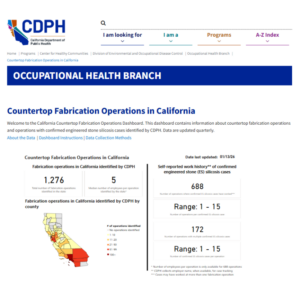
The California Department of Public Health (CDPH) has launched a new dashboard that sheds light on the alarming scope of accelerated silicosis among crystalline silica artificial stone countertop fabrication workers. According to the data, 688 fabrication shops—54% of the 1,276 confirmed shops—have reported silicosis cases. This is not a minor issue of a “few bad actors who don’t follow OSHA”; it is a public health crisis affecting hundreds of workplaces and thousands of workers across the state, because hundreds of peer reviewed medical studies demonstrate that crystalline silica artificial stone is so uniquely toxic that it cannot be safely fabricated by human beings in any fabrication workplace.
Understanding the Risk: What Workers Are Facing
Silicosis is a severe and incurable lung disease caused by inhaling respirable crystalline silica dust. Workers in the countertop fabrication industry are particularly vulnerable because crystalline silica artificial stone—also known as engineered, artificial or manufactured stone—contains at least 90% nano-sized silica, toxic metals, and toxic VOCs.
When cut, ground, or polished, this material releases toxic particles into the air, which are inhaled deep into the lungs.
A Systemic Issue
The CDPH data proves utterly false the notion that this epidemic is the result of a few “negligent” employers. With more than half of all fabrication shops reporting silicosis cases, it is clear that this is a systemic problem. The median shop size is just five employees, making it unrealistic for these small businesses to afford multi-million-dollar safety systems. Even if the installation and use of these safety systems we’re in place, as demonstrated in over 100 peer-reviewed scientific studies, we know that crystalline silica artificial stone cannot be fabricated safely by humans because of its unique characteristics not present in natural stone. This underscores the urgent need for awareness, prevention, and legal accountability for those harmed.
Why Is Silicosis So Dangerous?
Silicosis is progressive and irreversible. Symptoms include shortness of breath, fatigue, and persistent cough, leading to severe disability and death. In addition, exposure to silica dust increases the risk of lung cancer, autoimmune disorders, and other serious health conditions.
What Should You Do If You’ve Been Exposed?
If you or someone you know has worked in countertop fabrication of crystalline silica artificial stone—you may have been exposed to dangerous levels of silica dust. Early detection and legal guidance are critical. Brayton Purcell LLP has decades of experience representing individuals with occupational diseases, including silicosis.
Your Legal Rights Matter: We’re Here to Help
If you or someone you know has worked in the countertop fabrication industry and developed silicosis or related health issues, contact Brayton Purcell LLP today. Our accomplished legal team can help you understand your rights and pursue compensation for your injuries.
Call us at (800) 361-2417 or contact us online today for a free consultation.