

Mesothelioma Treatment Response: New Study Finds Radiologists Disagree in 35% of Cases
September 28, 2026
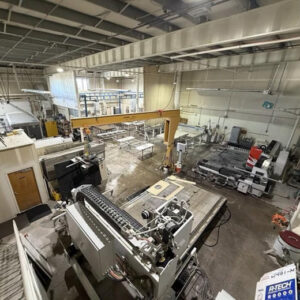
Stone cutting equipment sits in a fabrication facility where workers process engineered stone slabs.(InvestigateTV)
A recent episode of Bloomberg’s Big Take podcast, "Crafting America’s Favorite Countertops Is Killing Workers," explores a growing occupational disease crisis affecting workers across the United States. During the episode, host Sarah Holder speaks with Bloomberg labor reporter Josh Eidelson about the rise of artificial stone silicosis among workers who fabricate artificial stone countertops, the lawsuits filed by affected workers, and the ongoing debate over responsibility within the industry.
While artificial stone has become one of the most popular countertop materials in the country, the podcast focuses on a reality many consumers never see: the fatal health risks faced by countertop fabrication workers who cut, grind, polish, and shape the material during fabrication.
Artificial stone contains at least 90% nano-sized and ultra-fine high-surface area crystalline silica. The remaining approximately 10% consists of other highly toxic materials such as resins, dyes, and heavy metals. During fabrication, the material releases enormous quantities of toxic artificial stone dust and mist into the air.
Those particles are inhaled and penetrate deep into the lungs and become embedded in lung tissue. The resulting inflammation and scarring lead to artificial stone silicosis, a devastating, progressive, incurable, and fatal disease. Unlike many other occupational illnesses, artificial stone silicosis continues to progress long after exposure has ended.
As Josh Eidelson explained during the podcast, artificial stone differs dramatically from natural stone products because of its silica content. "Artificial stone can be around 93% crystalline silica," he noted, contrasting it with materials such as marble, which contain substantially less silica.
The episode emphasizes that the danger is not associated with the finished countertop installed in a home – at least not until later demolition. Instead, the hazard arises during fabrication, when countertop fabrication workers must transform massive rectangular slabs by cutting, grinding, and polishing them into finished products.
Eidelson offered a stark description of what happens after workers inhale respirable crystalline silica.
"Those particles cause lungs to get inflamed, to scar, to shrink, to harden," he explained. As the disease progresses, the damage ultimately results in respiratory failure.
The Bloomberg podcast leaves little doubt about the seriousness of silicosis. Eidelson recounted a physician's observation that she wished her patients with artificial stone silicosis had lung cancer instead, because lung cancer can "be cut out". When asked whether the disease is incurable, Eidelson's response was direct: "That's right," because artificial stone silicosis is fatal.
There is no cure for artificial stone silicosis. No medication can remove embedded silica particles or reverse the damage they cause. The fibrosis associated with silicosis permanently alters the structure of the lungs, and many workers also develop serious complications involving the kidneys, immune system, and other organs.
Tyler Jordan's Story
Much of the episode centers on the experience of Tyler Jordan, a former artificial stone countertop fabricator whose life changed dramatically after working with artificial stone.
Jordan began working in his family's fabrication business after graduating from high school. Like many workers entering the industry during the rapid growth of artificial stone, he was attracted to the work and hoped one day to take over the business.
"I loved that job," Jordan said. "I worked there in hopes of one day taking over that business."
As artificial stone became the dominant material in the shop, Jordan spent increasing amounts of his workday fabricating the product.
According to the podcast, he and many other workers were introduced to artificial stone through discussions centered on its benefits, while failing to warn workers of the health risks.
"The differences that we were told were all pros," Jordan recalled. "It's stronger, it's less porous, it won't stain."
While still in his twenties, Jordan began experiencing a range of troubling symptoms. He lost weight, developed severe pain, and endured worsening health problems that led to extensive medical testing.
"I had lost weight. I started waking up with pain, back pain, chest pain, and just everything was sore and tight," Jordan said.
Doctors initially searched for evidence of cancer and reportedly struggled to explain how a worker so young could be suffering from symptoms associated with an occupational lung disease.
Eventually, a lung biopsy confirmed the diagnosis.
Jordan had artificial stone silicosis.
The consequences extended far beyond his lungs.
"The silicosis kind of spiraled into a lot of other illnesses," Jordan explained. "Autoimmune disease and kidney failure."
Rather than taking over the family business, he ultimately received a kidney transplant from his father. He's had to leave the industry, relocate his family, and continues to live with the long-term consequences of the disease.
Jordan's experience illustrates why the artificial stone silicosis crisis has attracted growing attention from physicians, researchers, attorneys, regulators, and policymakers.
A Different Kind of Silicosis Epidemic
Silicosis is not a new disease. Evidence of silica-related lung damage has existed for thousands of years. What has changed is the age of many workers being diagnosed and the severity and rapid progression of the disease.
The podcast highlights a disturbing trend documented in countries around the world. Workers fabricating artificial stone are developing accelerated artificial stone silicosis at much younger ages than traditional silicosis patients.
"There are thousands of cases that have been identified around the world of artificial stone silicosis," Eidelson noted during the interview.
Historically, silicosis was often associated with workers who experienced silica exposure over several decades in industries such as mining. The artificial stone epidemic has altered that pattern. Workers in their twenties, thirties, and forties are now being diagnosed with severe disease, raising concerns among medical professionals and public health researchers.
Litigation and the Debate Over Responsibility
The Bloomberg episode also examines the litigation that has emerged as more workers have been diagnosed with artificial stone silicosis.
Approximately 700 U.S. workers have filed lawsuits throughout the United States against companies involved in the manufacturing and distributing of artificial stone slabs used to fabricate countertops. Workers generally allege that artificial stone is an extraordinarily, uniquely, and unnecessarily hazardous product and that the risks associated with fabrication were not adequately disclosed.
Manufacturers have denied wrongdoing and erroneously argue that artificial stone can be fabricated safely. According to Eidelson, many defendants maintain that the issue involves fabrication practices rather than the product itself.
The podcast discusses Tyler Jordan's lawsuit as one example of how juries are addressing these claims. It also explores the broader legal landscape as hundreds of similar cases move through courts.
At the same time, policymakers continue debating how best to respond to the crisis. Some proposals focus on restricting artificial stone fabrication, while another seeks to eliminate lawsuits involving manufacturers.
As Eidelson summarized during the podcast, "There are two very different paths being considered now in the United States. A ban on fabricating the product, or a ban on the lawsuits against the product."
The outcome of these debates will significantly influence the future of the artificial stone industry and the legal options available to workers diagnosed with artificial stone silicosis.
More Than a Legal Story
One of the most compelling aspects of Bloomberg's reporting is its focus on the human consequences of silica exposure.
Jordan's story illustrates how silicosis affects far more than a worker's lungs. Careers disappear. Families face financial strain. Medical complications multiply. Long-term plans are replaced with treatment, uncertainty, and significant life adjustments.
Today, Jordan says he is focused on spending time with his family and managing his health as best he can.
"Right now, it's just kind of living the best I can," he said.
His experience serves as a reminder that behind every lawsuit, policy proposal, and industry debate are workers and families whose lives have been permanently altered by an entirely preventable disease.
Bloomberg's Big Take episode goes beyond the headlines and legal filings. By combining medical realities, worker testimony, litigation developments, and public policy discussions, the episode paints a powerful picture of a growing occupational disease crisis that continues to affect workers throughout the United States.
To listen to the podcast, click here.
Contact Brayton Purcell LLP
A silicosis diagnosis can affect every aspect of a person's life. Medical treatment, lost income, diminished earning capacity, and the uncertainty of living with a fatal occupational disease can create enormous burdens for workers and their families.
If you worked as an artificial stone fabricator, countertop installer, cutter, polisher, grinder, or in another occupation involving artificial stone and have been diagnosed with silicosis, lung disease, autoimmune disease, kidney disease, or another silica-related illness, it is important to understand your legal rights.
The accomplished attorneys at Brayton Purcell LLP have devoted decades to representing workers and families affected by occupational diseases and toxic exposures. Our firm has extensive experience involving artificial stone silica exposure and occupational lung disease claims and understands the complex medical, scientific, and legal issues these cases often involve.
Important medical, employment, and exposure records can become more difficult to obtain as time passes. Understanding your legal options early can help preserve critical information related to your claim.
Contact Brayton Purcell LLP today for a free and confidential consultation to discuss your potential claim and learn whether legal remedies may be available to you and your family.