
Silicosis Surveillance in California, 2019-2024: Tracking an Epidemic
July 1, 2026
Pleural Effusion Symptoms, Causes and Mesothelioma Risks
June 26, 2026

Brayton Purcell LLP is honored to be selected as a finalist for the 2026 Trial Lawyer of the Year Award, presented by Public Justice. Public Justice is a nationwide non-profit public interest law firm dedicated to protecting people, the environment and access to justice. This national recognition is awarded annually to a trial lawyer or legal team whose work reflects exceptional skill, dedication, and a commitment to advancing the public interest through meaningful and recent legal victories. Being named one of just three finalists, chosen from approximately 25 nominations, highlights the significance of the firm’s work on behalf of individuals and families affected by serious occupational disease.
The award will be presented at a gala on July 24 in Chicago, where members of the Public Justice community will gather to celebrate advocacy that drives systemic change. As Public Justice notes, the event brings together “the legal community’s brightest stars and most accomplished advocates” at a critical moment, reinforcing a shared commitment to justice, accountability, and a legal system that works for everyone.
Recognizing Work That Advances the Public Interest
Public Justice’s Trial Lawyer of the Year Award honors litigation that creates meaningful change, not only for individual clients but for communities nationwide. The organization focuses on confronting systemic threats to justice, including abusive corporate practices, threats to civil rights, and environmental harm.
Its work spans several key areas, including defending access to the courts, protecting the environment, advancing civil rights, and addressing inequities in the justice system. Brayton Purcell LLP’s selection as a finalist reflects its continued commitment to these principles through complex litigation involving crystalline silica artificial stone and the development of silicosis among fabrication workers. Al Brayton, our founding partner, has supported Public Justice for decades, and is a past president of Public Justice and an Emeritus member of the Public Justice Board.
The Case Behind the Recognition
At the center of this recognition is the firm’s work in a case involving a countertop fabricator who developed advanced, fatal silicosis after years of working with artificial stone.
The Dangers of Artificial Stone
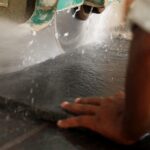
Crystalline silica artificial stone, also referred to as engineered or manufactured stone, is composed of at least 90% crystalline silica and approximately 10% other toxic materials, including glues, dyes, resins and other volatile organic compounds (VOCs). When fabricated, it releases nano-sized particles that are inhaled deep into the lungs.
A Worker's Story
The plaintiff, now 51 years old and dependent on supplemental oxygen, spent years cutting, grinding, and polishing crystalline silica artificial stone slabs. His dedication to supporting his family through hard physical work came at an unimaginably steep price: accelerated silicosis and pulmonary massive fibrosis, both terminal diseases caused by the nanosized crystalline silica particles released during routine fabrication.
Our client is married and has three children: a son and two daughters.
His catastrophic injuries from fabricating artificial stone slabs led to the need for a double lung transplant, which he received in 2025.
As one of his attorneys from Brayton Purcell said, “[He] is one of my favorite clients ever. He has been dealing with health issues because he caught a lung infection and has been in treatment for that for around 4–5 months. The bacteria were resistant to some antibiotics. He was hospitalized this year for around a month and was then sent home, and now a nurse goes to see him three times a week.
[He] is in love with his family. They are a very close family, the typical Latin family that wants a house so all the children and grandchildren can live together. [He] lives with his wife, three kids and grandchild.”
A Complex Legal Battle
Filed in late 2022 against 43 defendants responsible for exposing him to respirable crystalline silica, the case involved extensive investigation and complex legal issues, including claims that crystalline silica artificial stone products are inherently unsafe to fabricate and that the risks associated with respirable crystalline silica exposure were not adequately communicated. The unprecedented litigation required substantial discovery, extensive motion practice, and coordination with numerous witnesses and experts.
In April 2025, during jury selection, the litigation resulted in a recovery of more than $27 million for the worker and his family. This recovery represents one of the most significant in the United States involving disease associated with crystalline silica artificial stone exposure and reflects the seriousness of the harm caused by working with these materials.
The Growing Silicosis Crisis Among Artificial Stone Workers
Cases involving crystalline silica artificial stone exposure are part of a broader public health concern that continues to emerge across the United States and globally. Fabrication workers who are exposed to respirable crystalline silica dust face a significantly heightened risk of developing silicosis.
Rising Cases Across California
In recent years, the number of diagnosed cases has increased significantly, particularly in California. Many individuals affected are relatively young and from vulnerable working populations, often learning about the risks only after receiving a serious diagnosis. Silicosis can lead to progressive lung damage, oxygen dependence, the need for lung transplantation, and, in many cases, premature death.
Scientific Evidence
This issue has drawn growing international attention, with similar patterns observed in multiple countries. Public health authorities and regulatory bodies have begun to respond with increased monitoring, reporting requirements, and evolving restrictions related to crystalline silica artificial stone fabrication. Although the intent of these regulations is to provide safer working conditions for fabricators, over 100 peer-reviewed scientific studies have shown that crystalline silica artificial stone cannot be fabricated safely by human workers, even with the most advanced safety measures in place.
Litigation as a Tool for Accountability
The recognition from Public Justice reflects the important role litigation plays in addressing complex and evolving risks. Through detailed case development, scientific analysis, and persistent advocacy, cases like this help bring critical issues into public awareness.
These efforts require significant coordination, including identifying and interviewing coworkers, consulting with medical and scientific experts, and navigating extensive legal proceedings. The process not only seeks accountability in individual cases but also contributes to a broader understanding of the risks associated with crystalline silica artificial stone and its fabrication.
Brayton Purcell LLP has filed hundreds of cases on behalf of individuals affected by crystalline silica artificial stone exposure. Together, these cases aim to ensure that those impacted have meaningful access to the legal system, and that important questions about safety, risk, and responsibility are fully examined.
Honoring Clients and Looking Ahead
Being named a finalist for this award is a meaningful recognition of the individuals and families whose experiences are at the center of this work. Their stories reflect the human impact behind complex litigation and underscore the importance of access to justice for those facing serious illness.
The upcoming Public Justice gala in Chicago will celebrate not only the finalists but also the broader community of advocates working to protect civil rights, promote accountability, and advance fairness in the legal system.
A Continued Commitment
Brayton Purcell LLP remains committed to representing individuals and families affected by occupational disease, including those linked to crystalline silica artificial stone exposure. The firm’s selection as a finalist for the 2026 Trial Lawyer of the Year Award reflects years of accomplished work and an ongoing focus on addressing complex and emerging issues through the legal system.
As the legal community gathers in July, this recognition stands as both an honor and a reminder of the importance of thoughtful, persistent advocacy on behalf of those who need it most.
📞 Call (800) 361-2417