
California Moves Toward Banning Artificial Stone Amid Silicosis Crisis
June 3, 2026
How Epigenetics Is Reshaping Mesothelioma Research: Why EZH2 Matters
June 9, 2026
In a June 4, 2026, report for KQED News, journalist Farida Jhabvala Romero examines a federal legislative proposal that would dramatically alter the legal landscape for workers suffering from silicosis linked to artificial stone exposure. The bill, introduced by California Congressman Tom McClintock, would block hundreds of pending lawsuits and prevent future claims against artificial stone manufacturers and distributors, even as California continues to see severe and often fatal cases of the disease.
Federal Legislation with Immediate Consequences for Workers
According to Romero’s reporting for KQED, the proposed bill (H.R. 5437) would dismiss approximately 500 existing lawsuits, most of them filed in California by workers who developed silicosis after inhaling silica dust generated during the fabricating of artificial stone countertops.
The bill advanced out of the U.S. House Judiciary Committee on a party‑line vote. As Romero notes, Democratic members of the committee objected, arguing that the legislation would primarily benefit a small number of large manufacturers while denying legal recourse to workers suffering from an incurable occupational lung disease.
Artificial Stone and the Medical Evidence Cited by KQED
Romero’s KQED article highlights growing scientific concern about crystalline silica artificial stone, which is at least 90% crystalline silica, with the remaining portion made up of dyes, glues, resins and other highly toxic volatile organic compounds (VOCs). When artificial stone is cut or polished, it releases nano-sized silica particles that penetrate deep into the lungs.
Medical experts interviewed for the KQED report explained that workers are developing aggressive forms of silicosis even in shops that use commonly accepted dust‑suppression methods. Former OSHA official Dr. David Michaels warned of the broader implications of shielding manufacturers from liability:
“It is tragic that the Republican majority showed no interest in stopping this epidemic that is killing workers… Passage of this legislation will undoubtedly result in more workers being disabled by deadly dust.”
Competing Views on Responsibility
As detailed in the KQED report, supporters of the bill, including Rep. McClintock, argue that artificial stone slabs are safe when downstream fabrication shops follow proper safety measures. In comments cited by Romero, McClintock framed the legislation as a matter of fairness in civil litigation:
“This legislation addresses a fundamental question of fairness in our civil justice system… Who is liable when an otherwise safe product is misused?”
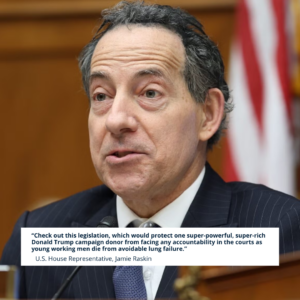
Opponents sharply disagreed. Romero reports that Rep. Jamie Raskin of Maryland criticized the bill for failing to address the silicosis epidemic itself, characterizing it as protection for wealthy corporate interests rather than a response to worker illness:
“Check out this legislation, which would protect one super‑powerful, super‑rich Donald Trump campaign donor from facing any accountability in the courts as young working men die from avoidable lung failure.”
In direct contradiction to McClintock’s statements, hundreds of peer-reviewed scientific studies have shown that crystalline silica artificial stone cannot be fabricated safely by human workers.
California’s Silicosis Crisis in Focus
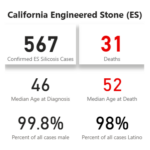
Romero’s reporting places the proposed federal immunity squarely within California’s broader public health crisis. California has confirmed more than 560 cases of silicosis, with at least 31 worker deaths since 2019 linked to artificial stone exposure. California remains the only state actively tracking the disease.
According to the KQED article, nearly all affected workers are low‑income Latino men who were unaware of the dangers associated with cutting and polishing artificial stone until they or their co‑workers became ill.
Litigation Outcomes Referenced by KQED
Romero reports that several lawsuits against artificial stone manufacturers have already resulted in substantial outcomes. James Nevin of Brayton Purcell LLP, quoted in the KQED article, explained that two of the three cases that reached verdicts resulted in jury awards of $52.4 million and $17.4 million, reflecting juries’ assessment of the severe harm suffered by workers.
Global Context and Industry Response
The KQED report also notes that Australia banned artificial stone in 2024, prompting some manufacturers to introduce lower‑silica products in the U.S. market. According to Romero, Cambria, the largest domestic producer of artificial stone, has not made that shift.
Romero further documents significant lobbying expenditures by major artificial stone companies as H.R. 5437 moves through Congress, underscoring the high financial stakes surrounding the legislation.
Need Help After Artificial Stone Silica Exposure?
Workers who cut, grind, polish, or fabricate artificial stone countertops may face devastating health risks from silica dust exposure. If you or a loved one has been diagnosed with silicosis after working with artificial stone, you may still have legal options.
At Brayton Purcell LLP, we stand with workers and families harmed by dangerous workplace exposures and companies that failed to protect them. Our attorneys have decades of experience pursuing justice for people with serious occupational lung diseases.
We are here to listen, explain your options, and fight for the accountability you deserve.
📞 Call (800) 361-2417